
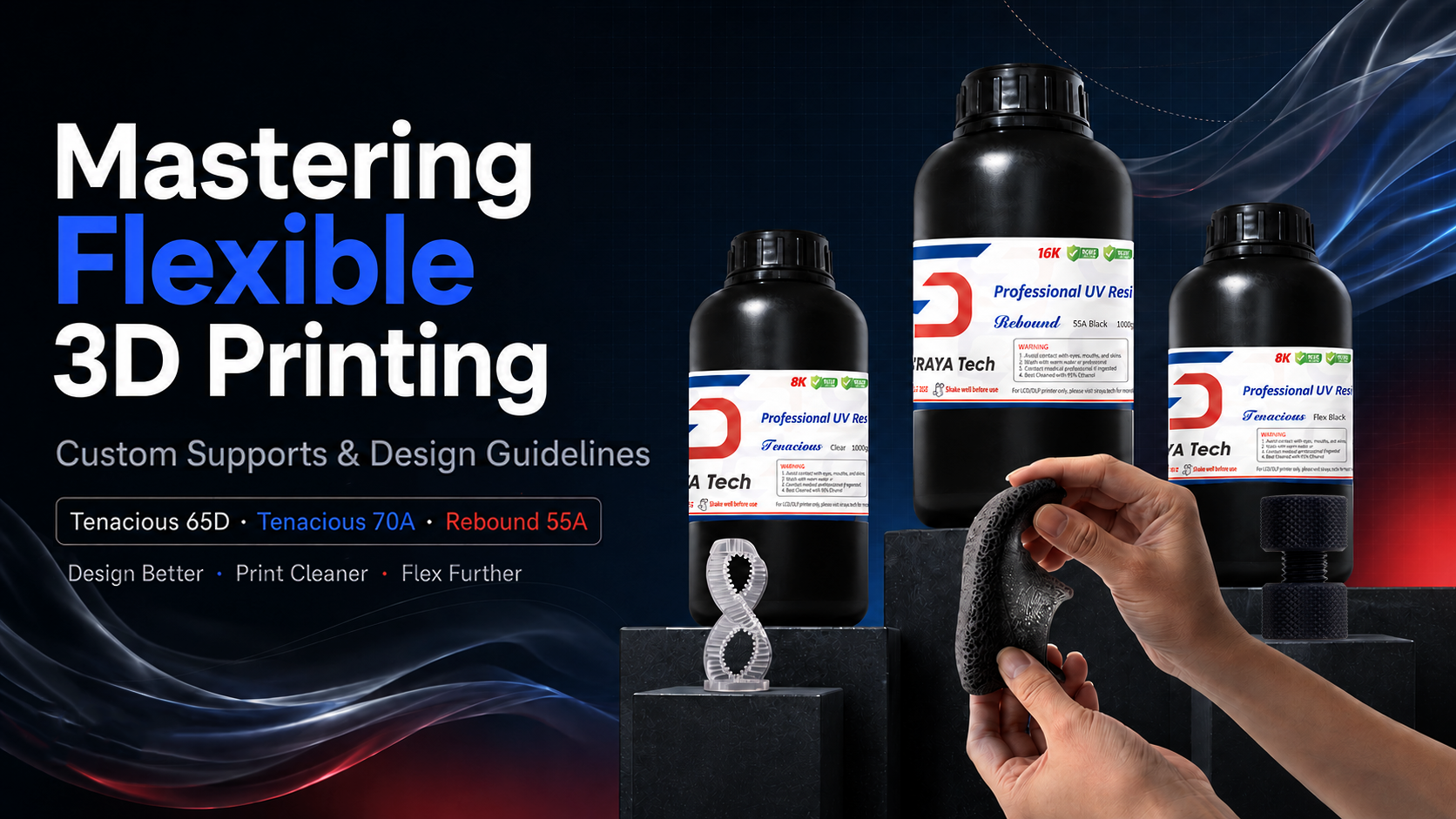
Printing with elastomeric, rubber-like 3D printing resins unlocks incredible potential for functional prototyping—from shock absorbers and gaskets to wearables and grips. However, flexible materials behave very differently than standard rigid resins.
Whether you are working with the high-rebound Siraya Tech Rebound 55A or dedicated true-silicone materials like Formlabs Silicone 40A Resin, standard auto-generated supports often fail to secure the print or leave ugly, destructive pockmarks upon removal.
By adopting advanced design philosophies—such as custom tearaway supports and strategic model orientation—you can achieve flawless surface finishes and drastically reduce print failures across all premium flexible resins.
Why Traditional Supports Fail with Soft Resins
With highly elastic materials (like Rebound's 55A Shore Hardness or Formlabs' 40A Shore Hardness), auto-generated slicer supports create two major problems:
- Model Shifting: Highly elastic parts stretch and compress between layers during the peel process, leading to poor layer registration and ripping, especially on thin-walled or bellows-like geometries.
- Surface Damage: Tearing away traditional support touchpoints from a soft material often gouges the model, ruining the professional finish and compromising structural integrity.
The Magic of Custom Tearaway Supports
Instead of relying on your slicer’s auto-supports, designing custom tearaway supports directly in your CAD software (like Fusion 360 or SolidWorks) will completely change your success rate. This is a highly recommended practice for anyone looking up design guidelines for Formlabs Silicone 40A Resin, and it applies perfectly to Siraya Tech Rebound 55A.
Essential Design Specifications for Flexible Resins
When modeling parts specifically for high-viscosity flexible materials like Siraya Tech Rebound 55A or Formlabs Silicone 40A, use these modified design minimums:
| Feature | Recommended Guideline | Why it Matters for Flexible Resins |
|---|---|---|
| Supported Wall Thickness | Minimum 1.0 mm | Prevents walls from stretching and tearing during the peel force phase. |
| Unsupported Wall Thickness | Recommended 2.0 mm | Flexible walls will easily buckle or wave if printed too thin without support. |
| Unsupported Angles | 45 degrees or greater | Shallower angles will droop heavily due to the softness of the uncured elastomer. |
| Vertical Wire / Pillar | Recommended 1.0 mm+ | Thin pillars will flex out of the way and miss their subsequent layers during printing. |
| Minimum Hole Diameter | 1.0 mm | High viscosity resins (~8000 CPS for Rebound) will easily clog smaller holes. |
Optimizing Orientation and Build Plate Adhesion
Highly elastic resins require careful build plate preparation. To maximize your success rate, ditch the raft where possible.
1. Print Directly on the Plate
Eliminates the need for bottom-surface support tips and provides an immovable base. Turn rafts off in your slicer.
2. Mind Your Edge Profiles
Models with sharp 90-degree bases print reliably. Avoid large radiused edges or rounded bottoms, which tend to curl and peel.
3. Avoid Expanding Areas
Orient parts so larger cross-sectional layers are closest to the plate to prevent immense peel forces higher up.
Capturing Traffic: From Formlabs Silicone 40A to Siraya Tech
If you found this guide while searching for "Formlabs Silicone 40A design guidelines", mastering these custom CAD supports, venting techniques, and edge-profile rules is the secret to unlocking true elastomeric printing.
Formlabs 40A boasts an impressive 230% elongation at break and 12 kN/m tear strength, relying heavily on these exact tearaway support strategies. For an accessible, high-performance alternative on desktop SLA/DLP printers, applying these exact guidelines to Siraya Tech Rebound 55A yields incredible results.
💡 Final Post-Processing Tips
Because flexible resins are viscous, ensure slicer settings accommodate your design with slow lift speeds and extended light-off delays.
For Siraya Tech Rebound 55A, wash thoroughly and perform a heat treatment (50°C for 60-90 minutes) before final UV curing. This evaporates absorbed solvents, ensures custom supports don't warp, and allows the part to achieve maximum rebound speed and dimensional accuracy.