
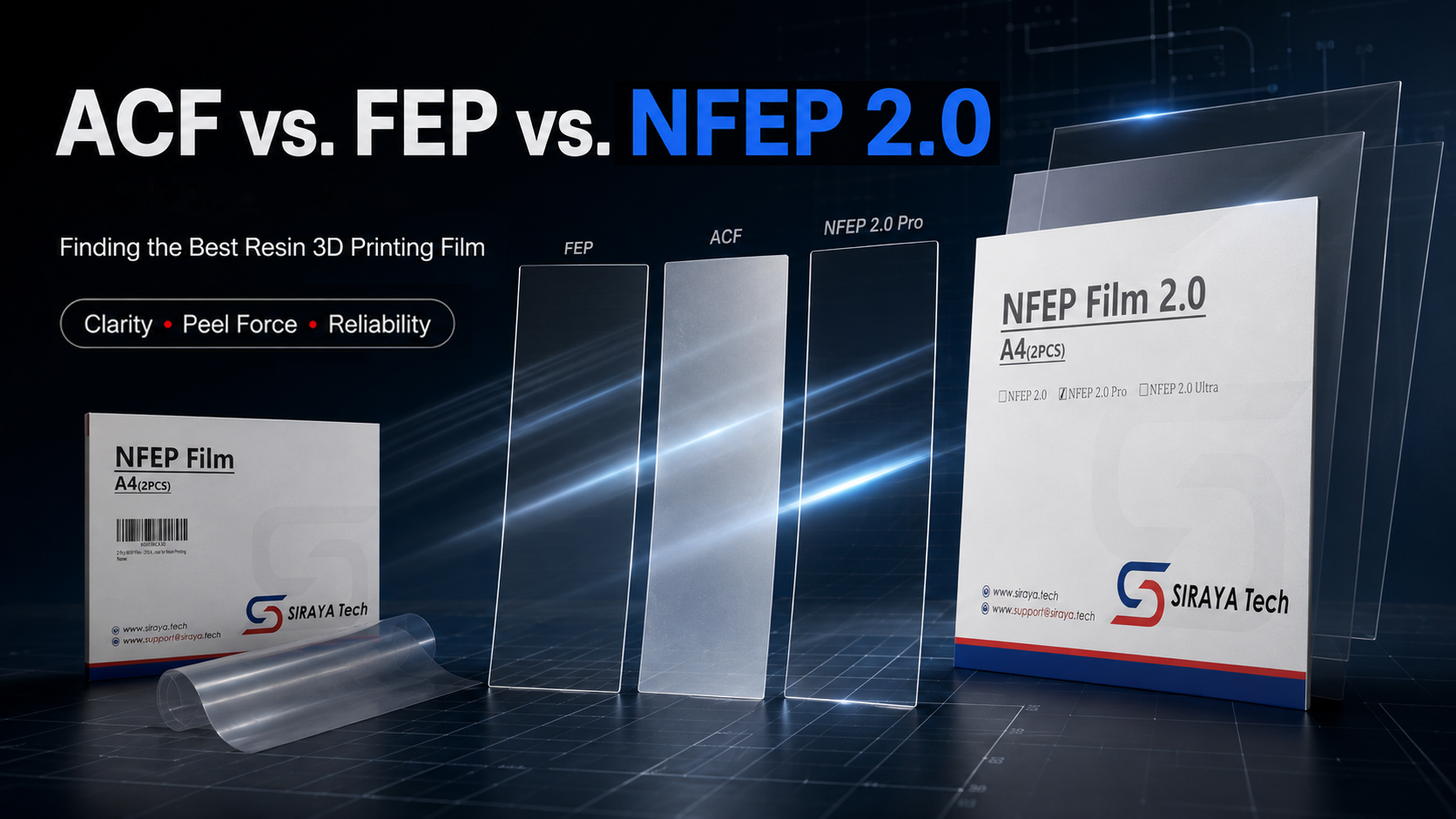
If you have spent any time in the resin 3D printing community, you know that the release film at the bottom of your vat is the unsung hero—or the ultimate villain—of your print success.
Over the years, resin 3D printing films have evolved rapidly. We started with standard FEP, upgraded to nFEP, transitioned to true PFA with NFEP 2.0, and recently saw a massive shift toward ACF film. But with all these acronyms and chemical names, which one should you actually use?
In this guide, we are exploring the delicate balance between print resolution and print success, why users have historically accepted the compromises of ACF film, and where the new Siraya Tech NFEP 2.0 Pro fits into your 3D printing workflow.
⚡ Quick Comparison Matrix
| Film Type | Peel Force | Resolution | Durability | Ideal For |
|---|---|---|---|---|
| Standard FEP | High | High | Moderate | Standard prints |
| nFEP / NFEP 2.0 | Medium | High | High | Miniatures & details |
| ACF Film | Ultra-Low | Low (Cloudy) | Brittle | Fast draft prints |
| NFEP 2.0 Pro | Ultra-Low | High (145μm) | High (PFA) | Large 8K/12K Prints |
The Baseline: FEP, nFEP, and NFEP 2.0 (PFA)
To understand where we are going, we need to clear up some common misconceptions about where we started.


The ACF Era: Trading Resolution for Reliability
To solve suction forces generated by massive 10-inch to 14-inch screens, ACF film promised an ultra-low peel force and fast print speeds. Lowering peel force protects expensive LCD screens from hardened resin pressed into the glass.
The Severe Trade-offs of ACF:
- Resolution Loss: Thick (300μm+) and cloudy, scattering UV light from 8K/12K screens and blurring details.
- Surface Artifacts: Imparts a distinct matte pattern or vertical lines on smooth surfaces.
- Fragility: Extremely brittle and prone to snapping if creased during installation.
- High Price: Considerably more expensive than standard FEP or PFA options.
Siraya Tech NFEP 2.0 Pro: The Ultimate ACF Alternative
Based on the reliable PFA foundation of NFEP 2.0, NFEP 2.0 Pro bridges the gap between high success rates and razor-sharp clarity without the bulk of ACF.
1. Micro-Matte Anti-Suction
The screen-facing texture breaks the vacuum seal, drastically reducing peeling tension on large prints.
2. 145μm Optical Clarity
Replaces chunky 300μm+ ACF with a 145μm profile, maximizing light transmittance for sharp 8K/12K details.
3. Smooth Resin Surface
Features a smooth resin-facing side, eliminating the textured "frosted" look associated with ACF.
4. Durable Pure PFA
Resists permanent stretching and won't snap during installation, outlasting fragile composites.
The Verdict: Which Film Should You Use?
Choose FEP, nFEP, or NFEP 2.0 if your priority is absolute micro-detail resolution on smaller-format machines, intricate jewelry, or detailed miniatures.
Choose NFEP 2.0 Pro if you print large models or run a print farm. It is the ultimate ACF alternative, delivering high reliability and low peel force while restoring optical clarity, a thin 145μm profile, and durability.
💡 Pro Installation Tip: Always install NFEP 2.0 Pro with the micro-matte side facing the LCD screen and the smooth side facing the resin to unlock its full anti-suction potential!