
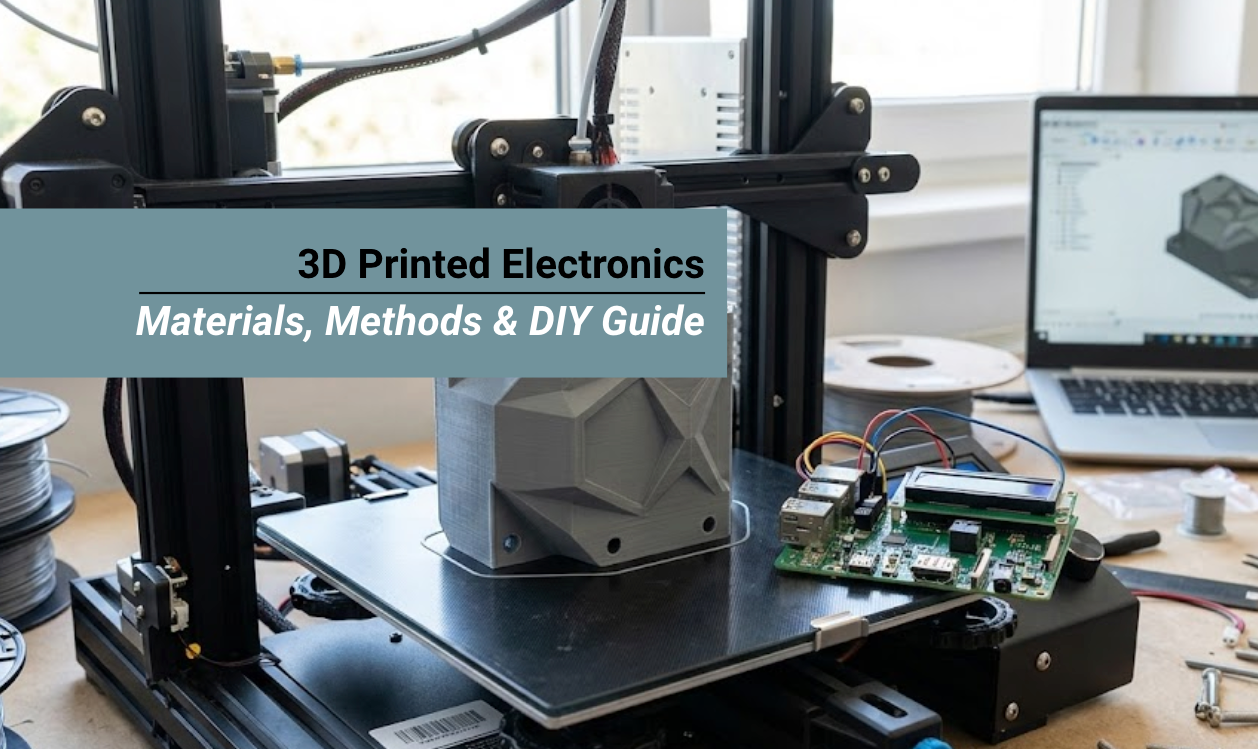
3D printed electronics are transforming how makers, engineers, and students create functional circuits.
Unlike traditional PCB manufacturing, which requires etching chemicals and specialized equipment, modern conductive filaments enable you to print working circuits, sensors, and RF antennas directly on FDM printers.
With Siraya Tech's carbon fiber filaments, you can embed conductive pathways into structural components—creating "smart objects" that combine mechanics with electronics in a single print.
What is 3D Printed Electronics?
Strictly speaking, 3D printed electronics involves depositing conductive inks or filaments to create circuitry within a 3D structure.
However, the broader and more accessible application involves using 3D printing to create:
- Enclosures and Housings: Protective shells that are custom-fitted to the PCB.
- Jigs and Fixtures: Tools to hold components during soldering or assembly.
- Embedded Electronics: Pausing a print to insert nuts, magnets, or even RFID tags and sensors directly inside the plastic part.
- Wearables: Flexible substrates for sensors and smartwatches.
While specialized machines (such as those from Nano Dimension or Voltera) handle the conductive traces, standard FDM and SLA printers using high-performance materials are the backbone of physical product design.
Table 1: 3D Printing Technologies for Electronics
|
Technology |
Resolution |
Best For |
Conductive Material |
Cost Range |
|
FDM (Dual Extrusion) |
±0.1mm |
DIY circuits, prototypes, sensors |
Carbon black PLA, Graphene PLA, Copper composite |
$300-$5,000 |
|
Direct Ink Writing |
±0.05mm |
High-resolution PCBs, flexible circuits |
Conductive pastes, silver ink |
$4,000-$150,000 |
|
Inkjet (Material Jetting) |
±0.01mm |
Miniature components, RFID tags |
Nanoparticle metallic inks |
$100,000-$400,000 |
|
Aerosol Jet |
±0.005mm |
RF antennas, micro-sensors |
Aerosol silver, carbon inks |
$250,000+ |
Applications of Siraya Tech Materials in Electronics

To ensure your electronic projects survive the real world, we recommend the following professional-grade filaments from the Siraya Tech Collection:
Enclosures and Casings
The most common application is the device housing.
- Indoor Devices: Siraya Tech ABS-GF provides a matte finish that hides layer lines and offers immense stiffness.
- Outdoor Devices: Electronics used outside (like weather sensors or doorbell cameras) need UV protection. Siraya Tech ASA is the gold standard here, as it resists UV degradation that would turn ABS yellow and brittle.
Wearable Technology
For smartwatches, fitness trackers, or cosplay electronics:
- Siraya Tech Flex TPU Air is a foaming filament. It is lightweight (low density) and soft (Shore 65A-82A), making it perfect for wristbands or headset cushioning.
- Siraya Tech Peopoly Lancer PPA-CF can be used for rigid, lightweight frames in AR/VR glasses due to its carbon fiber reinforcement.
Manufacturing Aids (ESD and Fixtures)
In a production environment, you often need "pogo pin" jigs to test PCBs.
- Siraya Tech Fast ABS-Like Resin is ideal for printing high-resolution testing jigs that require precise tolerances to align with test points on a circuit board.
Table 2: Material Selection for Electronic Components
|
Component Type |
Key Requirement |
Recommended Siraya Tech Material |
Why? |
|
PCB Enclosure (Indoor) |
Heat Resistance & Stiffness |
Glass fiber prevents warping; withstands component heat. |
|
|
IoT Sensor Housing (Outdoor) |
UV Resistance |
Will not degrade or crack under direct sunlight. |
|
|
Wearable Strap / Bumper |
Flexibility & Comfort |
Lightweight foaming texture feels soft against skin. |
|
|
Drone Frame / Chassis |
Strength-to-Weight Ratio |
Carbon fiber adds immense stiffness without weight. |
|
|
Light Diffuser (LEDs) |
Translucency |
Excellent for potting or creating |
Advanced: Resin-Based Conductive Electronics
While FDM dominates DIY electronics, resin printing can create ultra-fine conductive features using conductive resins mixed with carbon nanoparticles.
Best Siraya Tech Resin for Electronics Enclosures:
- Siraya Tech Blu: Tough, impact-resistant housings.
- Siraya Tech Sculpt Ultra: Heat-resistant (220°C HDT) for high-temperature electronics.
Conclusion
3D printed electronics democratize circuit fabrication, turning any FDM printer into a mini PCB factory. While professional inkjet systems offer higher precision, DIY makers can achieve functional results using affordable conductive filaments and dual-extrusion.
For structural components that house these circuits, Siraya Tech's carbon fiber filaments provide the strength and thermal stability modern electronics demand.
Frequently Asked Questions (FAQ)
Can you 3D print a working circuit board?
Yes, using dual-extrusion FDM printers with conductive filament (carbon black or copper composite). The traces won't match commercial PCB conductivity, but they work for low-current applications like LED circuits, sensors, and Arduino shields.
What is the most conductive 3D printing filament?
Electrifi (copper composite) offers 10,000 S/m conductivity—100x better than carbon black PLA. It's the only filament capable of powering circuits with standard 3-9V batteries without excessive voltage drop.
Can you solder directly to 3D printed conductive filament?
Yes. Copper-composite filaments accept solder. Carbon black PLA is harder to solder but can be done with flux and high heat. Alternatively, embed metal pads during printing for easier soldering.
Is 3D printed electronics cheaper than traditional PCB manufacturing?
For prototyping (1-10 units), yes. A simple 3D printed circuit costs ~$2 in materials vs. $30+ for custom PCB fabrication. For mass production (>100 units), traditional PCBs are still more cost-effective.
What software do I use to design 3D printed electronics?
For simple circuits: TinkerCAD or Fusion 360. For complex multi-layer PCBs: KiCad (export as 3D model) or specialized electronics CAD like Autodesk EAGLE. Slice using PrusaSlicer or Cura with dual-extrusion settings.
1 comment
Ian Ramsdell
Great overview. I especially like that you called out the difference between using 3D printing for enclosures, fixtures, wearables, and actually printing conductive features. That distinction gets missed a lot.
One area I’d add is that the conductive filament side is starting to move beyond carbon-loaded and traditional copper-composite polymer materials. At Kupros, Inc., we’ve been working on Cu29, an all-metal, conductive filament for standard FDM/FFF printers that can print circuits, antennas, sensors, and shielding directly into polymer parts with no post-processing.
That matters because a lot of the limitations around 3D printed electronics have come from conductivity, solderability, and whether the printed material can move beyond low-current demo circuits into more functional embedded electronics.
I think this is where the category is heading: not just housings around electronics, but electronics printed directly into the structure itself.
For anyone interested, more information is at https://kuprosinc.com