
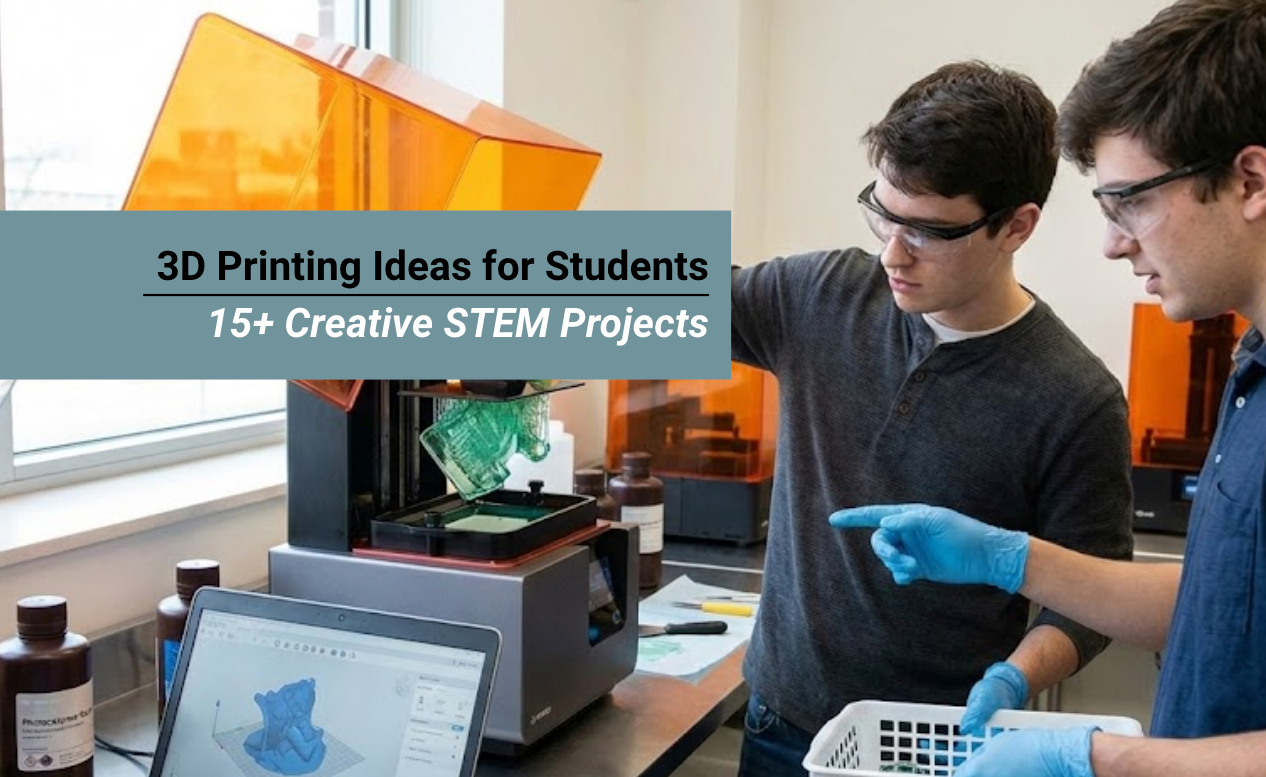
3D printing ideas for students have transformed modern education by turning abstract concepts into tangible learning experiences.
Whether introducing elementary students to basic geometry or challenging college students with biomedical engineering, 3D printing bridges the gap between theory and practice.
With Siraya Tech's precision resins, students can create museum-quality models that rival professional prototypes, from anatomical hearts to DNA helices.
Why 3D Printing Is Essential for Modern STEM Education
3D printing develops critical 21st-century skills: spatial reasoning, problem-solving, and design thinking.
Studies show that students using 3D-printed models demonstrate a 40% better understanding of complex concepts than those using traditional 2D diagrams.
Key Benefits:
- Tactile Learning: Holding a 3D-printed cell nucleus makes biology concepts 10x more memorable than textbook diagrams.
- Rapid Prototyping: Students can iterate designs in hours, not weeks.
- Cost-Effective: One bottle of Siraya Tech resin (~$30) can print 50+ educational models.
Table 1: Choosing the Right Tech: Resin vs Filament
Before diving into the projects, it is crucial to match the technology to the student's age and the project's needs.
| Technology | Best For | Precision | Recommended Material |
|---|---|---|---|
| Resin (SLA) | Anatomy, Molecular Structures, Miniatures | High (±0.01mm) | Siraya Tech Simple (Safe/Water Washable) |
| FDM (Filament) | Large Prototypes, Tools, Architectural Blocks | Medium (±0.1mm) | PLA or PETG |
| Hybrid | Complex projects needing both detail & strength | Varies | Resin + FDM Combo |
Elementary School 3D Printing Projects (Ages 6-11)

1. Geometric Solids Collection
STEM Focus: Geometry, Volume Calculation
Why It Works: Students can physically hold and count faces, edges, and vertices. Print in different colors to teach shape classification.
Best Material: Siraya Tech Simple (Water-Washable) – Safe for classroom use, easy cleanup.
2. Interlocking Earth Puzzle
STEM Focus: Geography, Continental Drift
Why It Works: This 3D puzzle teaches plate tectonics through hands-on assembly. Each continent piece locks together like Earth's original supercontinent, Pangaea.
Best Material: Siraya Tech Sculpt – High detail for coastline accuracy.
3. Fraction Learning Blocks
STEM Focus: Mathematics, Fractions
Why It Works: Visual learners grasp "1/4" instantly when they see a physical 3D block divided into quarters.
Pro Tip: Print in transparent resin to stack fractions and show equivalents visually.
Middle School 3D Printing Projects (Ages 12-14)
4. DNA Double Helix Model
STEM Focus: Biology, Genetics
Why It Works: Resin printing captures the intricate spiral structure that's impossible to recreate with pipe cleaners. Students can twist the model to understand base-pairing.
Best Material: Siraya Tech Craft Creative Resin (Glow in the Dark) – Print base pairs in different colors (Adenine-Red, Thymine-Blue, Guanine-Yellow, Cytosine-Green).
5. Working Mechanical Gears
STEM Focus: Engineering, Physics
Why It Works: Print-in-place gear systems teach torque, gear ratios, and mechanical advantage without assembly.
Settings: Use 0.05mm layer height for smooth gear teeth. Siraya Tech Fast's low shrinkage ensures perfect tolerances.
6. Topographic Map Models
STEM Focus: Geography, GIS
Why It Works: Students understand elevation changes by touching the terrain. Import real USGS data to print your school's local geography.
Best Material: Siraya Tech Blu – Tough enough for repeated classroom handling.
High School Projects (Ages 15-18)
7. Human Organ Cross-Sections
STEM Focus: Anatomy, Biology
Why It Works: A 3D-printed heart with visible chambers, valves, and vessels is more impactful than any diagram. Students can disassemble the model to explore internal structures.
Best Material: Siraya Tech Sculpt Ultra – Medical-grade precision (220°C HDT) for sterilizable models.
8. Molecular Models (Caffeine, Water, CO₂)
STEM Focus: Chemistry
Why It Works: Complex organic molecules become tangible. Print caffeine molecules to show resonance structures or water molecules to teach hydrogen bonding.
Print Time: ~2 hours per molecule (50mm scale).
9. Leonardo da Vinci Bridge
STEM Focus: Civil Engineering, Physics
Why It Works: This self-supporting bridge design teaches structural integrity without glue or fasteners. Students test load-bearing capacity by adding weights.
Challenge: Print multiple designs and conduct stress tests to failure.
10. Wind Turbine Prototype
STEM Focus: Renewable Energy, Engineering
Why It Works: Students design custom blades, test them with a fan, and measure power output with a voltmeter.
College-Level 3D Printing Projects (Ages 18+)

11. Prosthetic Hand Prototype
STEM Focus: Biomedical Engineering
Why It Works: Students design functional prosthetics with articulated fingers. This project combines CAD modeling, material science, and human-centered design.
Best Material: Siraya Tech Tenacious (Flexible) – Mix with Blu for impact-resistant joints.
12. Architectural Scale Models
STEM Focus: Architecture, Urban Planning
Why It Works: Resin printing captures intricate facade details, window frames, and textures that FDM printers miss.
Pro Tip: Use Siraya Tech Sculpt for heat-resistant models that won't warp under studio lights during presentations.
13. Microfluidic Devices
STEM Focus: Bioengineering, Lab-on-a-Chip
Why It Works: Students print functional microfluidic channels for chemical analysis or cell sorting. This is graduate-level research made accessible.
Requirements: Transparent resin + 405nm curing light.
14. Custom Lab Equipment
STEM Focus: Research, Innovation
Why It Works: Print custom pipette holders, test tube racks, or spectrophotometer cuvettes for a fraction of commercial costs.
Example: A $200 commercial cuvette holder can be printed for $5.
15. Constellation Viewer (Astronomy)
STEM Focus: Astronomy, Optics
Why It Works: Print a handheld planetarium that projects star patterns onto a wall. Students learn constellations and celestial navigation.
Best Material: Use opaque black resin for the body + transparent resin for star holes.
Table 2: Recommended Materials for Student Projects
|
Material Type |
Best Application |
Siraya Tech Recommendation |
Why for Students? |
|
Standard Resin |
Visual models, Art, Statues |
Fast printing allows for quick iteration; durable enough for handling. |
|
|
Engineering Resin |
Functional parts, Robotics |
Extremely strong; good for college engineering projects. |
|
|
Gears, Snap-fits, Outdoor tools |
withstands heat and stress; essential for working mechanical parts. |
||
|
Specialty Resin |
High-temp applications |
For advanced experiments involving heat or molds. |
Safety Guidelines for Classroom 3D Printing
Essential Rules:
- Always wear nitrile gloves when handling uncured resin.
- Work in ventilated areas – Resin fumes require airflow.
- UV cure fully – Uncured resin should never touch skin.
- Use water-washable resin for younger students to eliminate IPA hazards.
Teacher Tip: Siraya Tech Simple is the safest classroom choice, it washes with tap water and has minimal odor.
Conclusion
These 15 3D printing ideas for students transform abstract STEM concepts into hands-on learning experiences.
From elementary geometry blocks to college-level prosthetics, Siraya Tech resins provide the precision and safety educators need.
By integrating 3D printing into your curriculum, you're not just teaching science—you're preparing students for careers in engineering, medicine, and design.
Frequently Asked Questions (FAQs)
What are the best 3D printing projects for beginners?
For absolute beginners, "print-in-place" items like articulated animals (slugs, octopuses) or simple organizers like Gridfinity bins are best. These require minimal assembly and teach the basics of bed adhesion and slicing without the frustration of complex supports.
Is resin printing safe for students?
Resin printing can be safe for older students (high school and college) when proper safety protocols are followed. This includes wearing nitrile gloves, working in a well-ventilated area, and using low-odor resins like Siraya Tech Fast. For elementary students, FDM printing is generally preferred due to the lack of liquid chemicals.
How does 3D printing help STEM students?
3D printing turns passive learning into active learning. Instead of looking at a diagram of a gear, a student designs one, prints it, tests it, watches it fail, and redesigns it. This cycle of iterative design is the core of all engineering and scientific inquiry.
Can 3D printed parts be used for school robotics competitions?
Absolutely. Many robotics teams use 3D printed parts for custom brackets, sensor mounts, and protective covers. Using high-strength materials like Siraya Tech Blu (resin) or ABS-GF (Glass Fiber ABS) ensures these parts can withstand the rigors of competition.
Why should I use ABS instead of PLA for student engineering projects?
While PLA is easier to print, it deforms in heat (like a hot car) and is brittle. ABS is slightly flexible (ductile) and heat-resistant. For projects that require snap-together or friction-resistant components (such as the automata mentioned above), ABS is the superior choice for a functional, long-lasting part.