
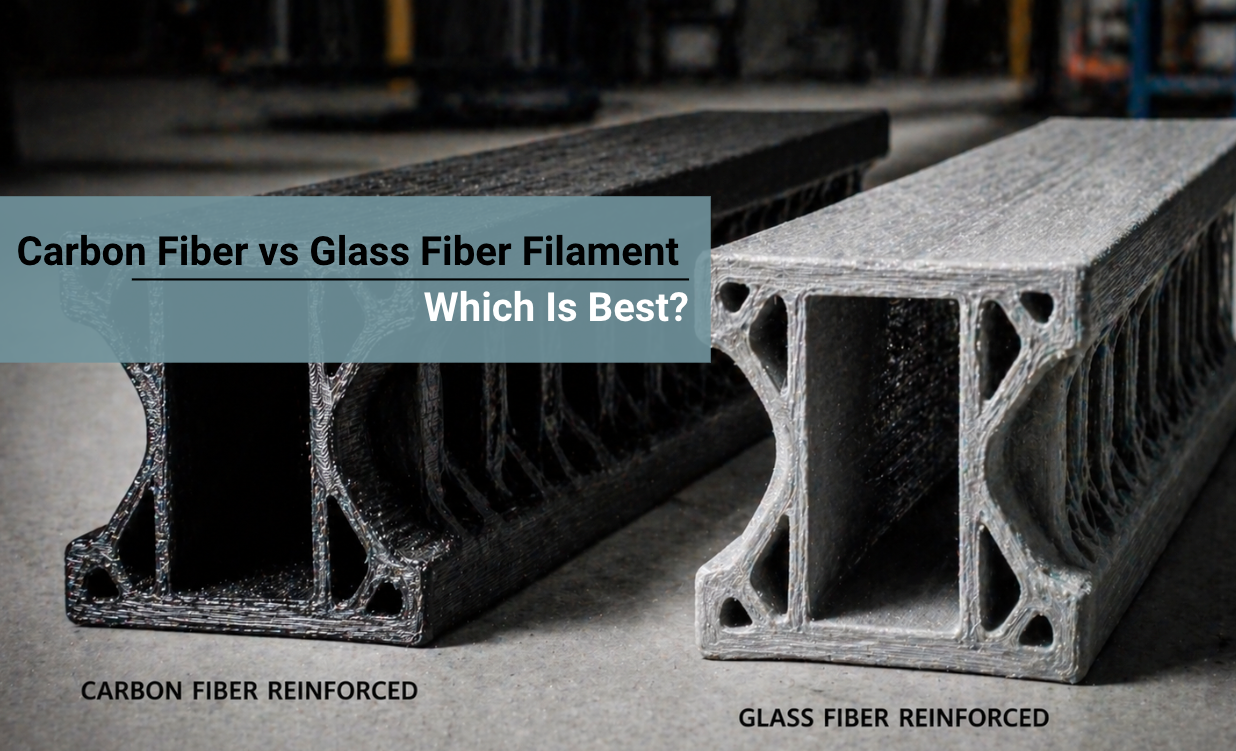
Carbon fiber is lighter and stiffer, while glass fiber is tougher and cheaper. Pick the wrong one, and you end up with a part that either shatters under impact or costs twice what it should.
This guide breaks down the numbers that matter for your next project.
- Carbon Fiber wins on stiffness and weight (2-3x stiffer than GF).
- Glass Fiber wins on impact resistance and price (costs 20-40% less).
- Hardened Nozzles are required for both; standard brass will wear out in days.
- Conductivity: CF can be slightly conductive; GF is a true insulator, perfect for electronics.
- Appearance: CF is always dark/black; GF can be any color including white and tinted shades.
What Are Carbon Fiber and Glass Fiber Filaments?

Both are composite filaments. You take a regular plastic base like PLA, ABS, PETG, PPA, or nylon, then mix in short fibers between 30 microns and 7 millimeters long. The fibers act like rebar in concrete.
They give the plastic a skeleton that holds shape under load and keeps the part from warping as it cools.
Two main fiber types dominate the 3D printing market:
-
Carbon fiber (CF) is made by heating polyacrylonitrile (PAN) fibers until only carbon atoms remain. The result is a black fiber that is extremely stiff and light.
-
Glass fiber (GF) is made by melting silica sand and drawing it into ultra-thin strands. The result is a white fiber that is tougher and cheaper than carbon, but heavier and less stiff.
In filament form, both show up as "chopped" (short fibers under 1mm), "long fiber" (up to 7mm), or "core-concentrated" (fibers in the center of the filament strand only). Chopped is the most common for hobby printers.
Carbon Fiber vs Glass Fiber: The Head-to-Head
Here is where the real differences show up. These numbers come from published spec sheets for PPA-based composites, which are the most common engineering base polymer for both.
Table 1: Carbon Fiber vs Glass Fiber Filament Side by Side
| Property | Carbon Fiber (CF) | Glass Fiber (GF) | Winner |
|---|---|---|---|
| Tensile strength (MPa) | 85 to 110 | 70 to 90 | Carbon fiber |
| Stiffness (Young's modulus, GPa) | 6 to 10 | 3 to 5 | Carbon fiber |
| Impact resistance (kJ/m²) | 6 to 10 | 10 to 18 | Glass fiber |
| Density (g/cm³) | 1.10 to 1.18 | 1.25 to 1.40 | Carbon fiber (lighter) |
| Heat deflection temp (HDT) | 130 to 230°C | 140 to 185°C | Tie, varies by base |
| Color options | Black only | Any color | Glass fiber |
| Electrical conductivity | Slightly conductive | Insulator | GF for electronics |
| Typical cost per kg | $55 to $100 | $35 to $60 | Glass fiber |
| Nozzle wear | High | Very high | Tie (both abrasive) |
| Shrink rate | ~0.1% | ~0.2% | Carbon fiber |
Quick read: Carbon fiber is the lighter, stiffer, more dimensionally accurate option; glass fiber is the tougher, cheaper, more impact-resistant option. Both are vastly stronger than unfilled plastics.
When to Pick Carbon Fiber Filament

Carbon fiber is the right call when rigidity and precision are non-negotiable. The extremely low shrink rate makes it perfect for parts where "close enough" isn't good enough.
- Robotics & Drones: High stiffness-to-weight ratio helps stabilize frames and camera mounts.
- Engineering Jigs: Stays flat and maintains tight tolerances for CNC or assembly fixtures.
- Automotive: PPA-CF handles engines heat (up to 230°C) without losing its shape.
When to Pick Glass Fiber Filament
Glass fiber is the "workhorse" composite. If you expect a part to be handled roughly or dropped, GF will often outperform the stiffer, more brittle CF.
- Tool Handles: Impact resistance prevents shattering during sudden shocks or drops.
- Electronics Enclosures: GF acts as a clean insulator, removing the risk of shorts in tight sensor housings.
- Outdoor Use: ASA-GF provides UV stability and color variety for signage and garden furniture.
The downsides of glass fiber:
GF is heavier than CF at the same volume. It is also slightly less stiff, which means brackets and structural parts can flex more under load.
And glass fiber is actually more abrasive on nozzles than carbon fiber, so plan on ruby or hardened steel if you print GF in bulk.
Real Use Cases: Which One Wins Where
Here is how the picks break down by project type, based on published data and real print shop use.
-
Drone frame: Carbon fiber. Light, stiff, damps motor vibration.
-
RC car suspension arm: Glass fiber. Survives crashes without snapping.
-
Under-hood car bracket: Carbon fiber (PPA-CF). 230°C HDT handles engine heat.
-
Outdoor sign or enclosure: Glass fiber (ASA-GF). UV stable, any color.
-
CNC machine jig: Carbon fiber. Tight tolerances, stays flat.
-
Tool handle or wrench: Glass fiber. Drops and impacts won't shatter it.
-
Electronics housing with sensors: Glass fiber. No risk of shorts.
-
Camera mount: Carbon fiber. Lightweight and stiff.
-
Garden furniture part: Glass fiber (ASA-GF). UV plus impact resistance.
-
Structural bracket for a machine: Carbon fiber if weight matters, glass fiber if cost does.
Print Settings & Hardware Requirements
| Requirement | Carbon Fiber | Glass Fiber |
|---|---|---|
| Nozzle material | Hardened steel or ruby | Hardened steel or ruby |
| Minimum nozzle size | 0.4mm (0.6mm preferred) | 0.4mm (0.6mm preferred) |
| Printer enclosure | Yes for PPA-CF, ABS-CF | Yes for PPA-GF, ABS-GF |
| Direct drive extruder | Strongly recommended | Strongly recommended |
| Filament dryer | Required for nylon-based (PPA-CF) | Required for nylon-based (PPA-GF) |
| AMS / multi-material systems | Not recommended (brittle) | Not recommended (brittle) |
| Typical nozzle temp | 250 to 300°C | 240 to 290°C |
| Typical bed temp | 90 to 110°C | 90 to 110°C |
| Cooling fan | 0 to 30% | 0 to 30% |
| Print speed | 40 to 60 mm/s | 40 to 60 mm/s |
| Expected nozzle life | 100 to 300 hours (brass: 10 hours) | 80 to 250 hours (brass: 5 to 10 hours) |
Which Base Polymer Matters More Than You Think
Here is a detail most articles skip. "Carbon fiber filament" is not one thing. CF added to PLA behaves completely differently from CF added to nylon. Same for GF. The base polymer decides 70 percent of how the final part performs.
-
PLA-CF: Stiff but still soft at 55°C. Looks premium, fails in cars.
-
PETG-CF: Solid all-rounder, moderate heat tolerance, more brittle than PETG.
-
ABS-CF or ABS-GF: Good heat tolerance (up to 100°C), pro-grade look, easier to print than nylon.
-
PPA-CF or PPA-GF (PAHT): Top tier. Heat up to 230°C after annealing, industrial durability.
-
ASA-GF: UV stable, outdoor friendly, keeps its color.
Pick the base polymer first (based on heat, chemistry, and UV needs), then decide between CF or GF reinforcement.
FAQs: Carbon Fiber vs Glass Fiber
Is carbon fiber stronger than glass fiber filament?
Neither is universally stronger. Carbon fiber is stiffer and has higher tensile strength, winning for load-bearing structural parts. Glass fiber has higher impact resistance, winning for anything that takes sudden hits, like tools and covers.
Does carbon fiber filament conduct electricity?
Yes, but only a little. Carbon fiber is semi-conductive. For tight electronics enclosures or parts near high-voltage components, use glass fiber instead. GF is a true electrical insulator and is safer for electronics.
Do I need a hardened nozzle for these filaments?
Yes, always. Both fibers are harder than brass and will wear a brass nozzle down in 5 to 10 hours. Use hardened steel or ruby nozzles and plan on replacing them every 100 to 300 hours of printing.
Can you print fiber filaments on a Bambu AMS?
No, it is not recommended. Fiber-reinforced filaments are brittle, and tight bends inside an AMS feed path cause snapping. Load them manually through a direct drive extruder instead.
Which is cheaper, carbon fiber or glass fiber?
Glass fiber is cheaper by 20% to 40% at the same fiber loading. A kilogram of PPA-GF typically runs $45 to $55, while the equivalent PPA-CF runs $65 to $85.
Final Thoughts
Picking between carbon fiber vs glass fiber filament comes down to what your part actually has to do. If you need stiffness, precision, and low weight, go carbon fiber. If you need impact resistance, color variety, and lower cost, go glass fiber.
The biggest mistake makers make is thinking "carbon fiber is always the premium upgrade." It's not. For a tool handle that might get dropped, glass fiber is the smarter buy. For a camera mount that needs to hit exact angles, carbon fiber is worth every dollar.
Recommended Products & Collections
- Premium CF: Siraya PPA-CF Filament Collection (Top heat & stiffness).
- Premium GF: Siraya Fibreheart PPA-GF Filament (Industrial toughness).
- Automotive: Fibreheart ABS-CF Filament for rigid car parts.
- Outdoor: Fibreheart ASA-GF Filament for UV-stable outdoor prints.