
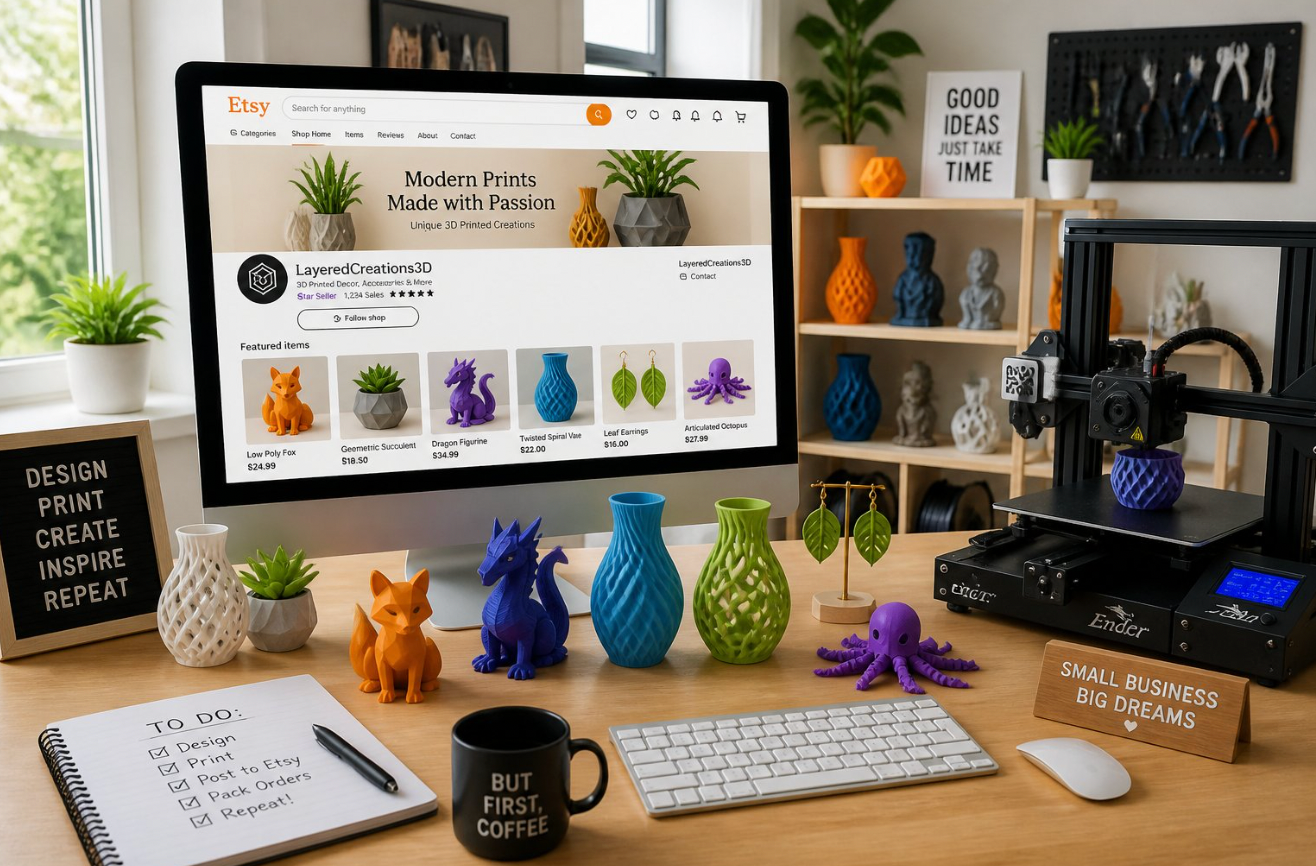
Whether you make prototypes, short-run products, or replacement parts, your printer choice shapes your margins and lead times.
Choose a 3D printer that matches your production volume, material needs, and budget. Prioritize reliability, service, and total cost of ownership over flashy specs.
You can start selling 3D prints on Etsy today by choosing a clear niche and setting up a compliant shop. List high-quality products that solve real buyer needs.
Focus on great photos, precise descriptions, and fair shipping. This helps people find and trust your 3D printed products quickly.
Expect practical steps, tools, and tips you can use right away to turn printing time into steady sales.
- Set up legally first: Pick a shop name, write clear policies, and verify commercial licenses before listing.
- Sell what people search for: Functional decor, personalized items, and niche hobby products outperform generic prints.
- Photos do the heavy lifting: 5–8 images per listing, including a scale shot and a lifestyle shot.
- Price for real costs: Cover filament, time, Etsy fees, and a 30–50% margin—don't undercut yourself.
- Use long-tail keywords: Title, tags, and the first sentence of the description drive Etsy search rankings.
Getting Started: Shop Setup and Legal Essentials
Set up your shop name, clear policies, and correct licensing before listing items. Decide how you will handle production, processing time, and taxes to avoid order problems.
Naming Your Etsy Shop
Pick a shop name that matches your brand and is easy to spell. Keep it under Etsy’s 20-character limit and avoid confusing punctuation.
Search Etsy and Google to confirm the name isn’t already used or trademarked. Use keywords in your shop title and about section to help buyers find you.
If you plan to use your own website later, check domain availability for the same name. Register the name on major social platforms if you expect growth.
Shop Policies and Processing Time
Write clear policies for shipping, returns, cancellations, and custom orders. State exact processing time like “3–7 business days.”
Include how you handle delays and who pays return shipping. List whether you sell physical 3D prints, digital downloads (STL files), or both.
Explain packaging, tracking, and insurance for higher-value items. Add a note about Etsy fees and transaction fees so you remember to factor them into price and shipping choices.
Commercial Licensing and Copyright Compliance
Only sell designs you created or use models with explicit commercial license. Read license files for purchased or free STL files.
Some files allow selling printed items but forbid selling the STL itself. Avoid fan art of copyrighted characters unless you have a license.
If you sell digital downloads, provide only files you have rights to distribute. Keep proof of licenses and purchase receipts in your records.
Etsy removes infringing listings without warning and repeat violations get shops suspended. When in doubt about a model's license, don't list it—contact the designer or use clearly commercial-licensed files.
Business Registration and Tax Considerations
Check local rules for small business registration and sales tax collection. Many places require registration if you sell regularly or exceed a revenue threshold.
Use Etsy’s tools to collect sales tax where required, but confirm rates for your products. Track all income and expenses, including materials, printer maintenance, and Etsy fees.
Consider a separate bank account for your Etsy shop to simplify bookkeeping. If you expect steady revenue, consult an accountant about estimated taxes and whether to form an LLC.
Choosing and Creating High-Demand 3D Printed Items
Focus on products that match clear buyer needs and are easy to print reliably. Choose items that let you charge for customization or design.
Prioritize products with short print time, low post-processing, and strong visual appeal.
Selecting a Profitable Niche
Pick a niche where buyers search often and will pay for uniqueness. Look at Etsy search trends, competitor shops, and forums to spot gaps.
Examples include niche pet accessories, tabletop miniatures, and hobby parts. Test demand by listing a few low-cost items or digital downloads.
Track views, favorites, and conversion rate for each listing.
Use pricing that covers material, machine time, and labor. Aim for 3x material+time cost when starting.
Focus on niches that let you scale with a print farm or offer personalization. Avoid ultra-commoditized goods where margins are tiny and competition is mostly mass-produced.
Sources for STL Files and Model Licenses
Choose STL sources with clear licenses to avoid takedowns and legal risk. Use Thingiverse, MyMiniFactory, or Cults3D for free and paid models.
Check whether the file has a commercial or non-commercial license. Confirm "commercial use" or purchase a commercial license when downloading or buying.
Keep receipts and license files organized per model. For exclusive designs, buy an extended or commercial license that covers physical and digital file sales.
Consider hiring designers for unique models. Maintain a folder with license details, model author, and allowed uses.
Using CAD and AI Tools for Unique Designs
Use Blender, Fusion 360, or ZBrush to create or edit models. Blender is good for organic shapes and renders.
Fusion 360 works best for precise, functional parts. ZBrush is ideal for detailed sculptures or character pieces.
AI-assisted design tools can speed up concepting and iteration. Use text-to-3D or mesh-editing plugins carefully and always check printability.
Export STL, run mesh checks, and slice to confirm wall thickness and supports. Prototype prints before listing.
Optimize orientation, infill, and layer height to reduce print time while keeping strength. Save editable CAD files so you can offer personalization or different sizes.
Popular Product Ideas: Decor, Functional, and Personalized
Decor: Wall art, vases, and planters with bold shapes sell well. Offer size options and finishes like paint or metallic spray. Showcase staged photos to highlight scale and texture.
Functional items: Phone stands, cable organizers, and cookie cutters solve daily problems. Design for easy printing and little post-processing. Provide assembly notes if multiple parts are needed.
Personalized items: Engraved name keychains, pet tags, and custom board game tokens command higher prices. Offer editable fields in your listing or sell digital downloads of the STL.
Use commercial-licensed templates or your own CAD files to keep listings safe.
Creating Compelling Etsy Listings and Driving Sales
Focus on clean photos, clear product details, smart pricing, and search-ready text. Tweak listings for Etsy SEO and conversions.
Professional Photography and Visual Presentation
Use at least 5–8 photos per product listing. Include a main clean white-background shot and a scale photo with a ruler or hand.
Add close-ups of texture and layer lines and lifestyle shots showing the item in use. Show each material or color if you sell variants.
Keep lighting soft and even. Use a neutral backdrop and consistent camera angle across listings. Crop to 1000–2000 px wide for clear zooming.
Add a short video (5–15 seconds) that rotates the item to boost conversion.
Write short photo captions that point out features like “removable lid” or “water-resistant finish.” These help buyers scan images and reduce questions.
Writing SEO-Optimized Descriptions and Titles
Put the most important long-tail keyword at the start of your title. Example: “Miniature Planter 3D Printed — Succulent Pot for Desk, PLA, 2.5”.
Use natural language and include material, size, use case, and target buyer.
Start the product description with a one or two sentence summary that answers “what it is” and “who it’s for.”
Follow with bullet points for dimensions, material, printing resolution, and shipping time. Add a short care and compatibility section (e.g., “fits standard 20 mm pot”).
Use tags and attributes to match Etsy searches. Include 13 tags mixing single words and long-tail phrases like “3d printed planter” and “desk succulent gift.”
Tools like eRank or Marmalead can help choose high-converting long-tail keywords.
Pricing Strategies and Profit Margins
Calculate true cost per unit: filament, electricity, printer wear, labor, finishing, packing, and shipping materials.
Add Etsy fees: listing (per item), transaction fee, payment processing, and possible ads spend.
Set a target profit margin, commonly 30–50% for small makers. Example: total cost $6 → price $12–15.
Offer tiered pricing for bundles or custom finishes to increase average order value. Use “free shipping” only if you build shipping into the price.
Monitor competitor pricing and your sales data. If conversions are low, test small price changes, run Etsy Ads, or offer limited-time discounts.
Track ROI on ads. If ad spend per sale exceeds profit, pause or refine keywords.
Optimizing for Etsy SEO and Conversion
Optimize listings for Etsy’s search: title, tags, category, attributes, and early description matter.
Use long-tail keywords that match buyer intent. Update keywords seasonally and after studying search performance.
Improve conversion by highlighting trust signals like clear production time and accurate shipping windows.
Encourage reviews by adding a polite note in the package and following up through Etsy’s messaging when delivery is confirmed.
Use Etsy Ads and offsite ads carefully. Start with a small daily ad budget and track which keywords drive sales. Prioritize listings with good images and reviews for ad spend.
Regularly A/B test photos, titles, and pricing to raise click-through and conversion rates.
Fulfilling Orders, Customer Experience, and Scaling
You will need reliable shipping and clear customer support. Focus on fast fulfillment and protective packaging.
Encourage repeat buyers through social and email marketing. Plan for scaling with options like print farms or wholesale.
Managing Shipping Logistics and Packaging
Set up Etsy shipping profiles for each product size and weight. Use accurate package dimensions and real carrier rates to avoid surprises.
Offer tracked shipping and a local pickup option if you handle in-person sales.
Choose packaging materials that protect PLA/ABS prints, such as bubble wrap, corrugated boxes, and foam inserts for delicate parts. Add a small plastic bag for dust and a label that shows fragile handling.
Include printed packing slips with the order number and simple care instructions.
Calculate production cost plus shipping when you price items. Mark packaging cost separately so you can adjust profiles easily.
Consider shipping insurance for higher-value pieces. Set clear handling times in your listings.
Customer Support and Building Repeat Buyers
Respond quickly to messages—aim for under 24 hours on weekdays.
Use saved replies for common questions like customization, material choice, or lead time to keep replies consistent and fast.
Encourage feedback by sending a polite message after delivery asking if the print arrived as expected. Include a small thank-you card in the package with care tips and a discount code for the buyer’s next purchase.
Track returns and complaints to find recurring issues like weak supports or brittle print settings. Fix the print files or adjust quality checks.
Keep a simple CRM, like a spreadsheet or Etsy convo notes, to remember repeat buyers and custom requests.
Marketing Through Social Media and Email
Build an email list with a signup link in your Etsy shop and on the packing slip. Send short, monthly newsletters that show new designs, restocks, and exclusive promo codes.
Keep subject lines specific, like “New Resin Miniatures + 15% for Subscribers.”
Post process shots and finished items on Instagram and TikTok to show quality and scale. Use short videos that highlight detail, post time-lapse prints, and add price or shop link in the caption.
Join relevant Facebook groups and contribute helpful advice before posting products.
Use product tags and descriptions with clear keywords such as “3D printed vase,” “custom keychain,” or “STL file download.”
Scaling Up: Print Farms and Wholesale Opportunities
Plan capacity before demand spikes. For small scale, add one or two printers and stagger maintenance to keep uptime high.
Track hourly print time, failure rate, and post-processing labor to calculate true production cost.
For larger scale, set up a print farm with uniform printers and spare parts inventory. Use simple workflow software or spreadsheets to assign jobs, track filament use, and manage quality checks.
Outsource polishing, painting, or assembly when it becomes a bottleneck.
Explore wholesale by offering bulk pricing to retailers or makers. Create a wholesale catalog with lead times, minimum order quantities, and net payment terms.
Final Thoughts
Selling 3D prints on Etsy rewards sellers who treat it like a business: clean shop setup, real cost accounting, professional photos, and consistent customer service.
Start narrow, validate demand with a small batch of listings, and reinvest profits into better photography, materials, and capacity once a niche proves itself.
Browse Siraya Tech’s 3D printer filament selection to find materials that match the quality buyers expect from a high-converting Etsy listing.
Related Reading on Siraya
- Ways to Make Money With a 3D Printer
- How to Design 3D Prints Like a Pro
- 3D Printing Tips: 15 Essential Techniques
- Best Way to Mass Print Big Models on a Resin Printer
- Useful Things to 3D Print
Frequently Asked Questions
What are Etsy's rules and policies for listing 3D-printed items?
Etsy requires honest listings that state how an item is made. You must say if you design items, use someone else’s design, or use a production partner. Do not list items that infringe copyright, trademark, or other IP. Etsy removes listings and can suspend shops for repeated violations. Follow Etsy’s handmade policy if you sell under a “made by you” listing. If a third-party prints for you, disclose that in the item description and shop policies.
Do I need a commercial license to sell prints made from someone else's STL files?
Yes, you usually need a commercial license when you sell physical prints made from another designer’s STL. Check the specific license that comes with the STL before you sell anything. Some creators sell files under “personal use only,” and selling prints made from those files violates that license. Buy or request a commercial license or use files marked for commercial use. Keep documentation of licenses and permission emails.
Which 3D-printed product types tend to sell best on Etsy?
Functional home items sell well, such as planters, hooks, and kitchen tools that show clear utility. Small jewelry and custom wearables attract buyers who want unique, lightweight pieces. Niche accessories for hobbies and gaming—miniatures, dice towers, and custom game pieces—have steady demand. Personalized keychains, nameplates, and small decor with custom text perform well too.
How should I price 3D-printed products to cover materials, print time, and Etsy fees?
Calculate material cost per item first: filament, resin, adhesives, and any post-processing supplies. Include packaging and any labeling or inserts. Add labor cost using a per-hour rate multiplied by print and post-processing time. Factor machine wear and occasional failed prints with a small overhead percentage. Finally, add Etsy fees: listing fee ($0.20 per listing) and transaction and payment processing fees.
How can I optimize titles, tags, and photos to rank in Etsy search?
Use clear, specific keywords buyers use, such as “3D printed planter,” “custom name keychain,” or “D&D miniature printable.” Put the most important keywords near the start of the title. Use all allowed tags and include synonyms and related phrases. Take high-quality photos on a neutral background that show scale and detail. Include at least one photo showing the item in use, one close-up of texture, and one image that shows size relative to a common object.
What shipping and packaging practices reduce damage and returns for 3D-printed orders?
Use bubble wrap or foam padding to protect fragile parts. Reduce movement inside the box by securing items well. Double-box fragile or complex items for extra protection during transit. Choose a sturdy box for shipping and fill empty space with crinkle paper or air pillows. Mark packages “fragile” only if the carrier recognizes the note. Offer tracking and insured shipping for higher-value items.