
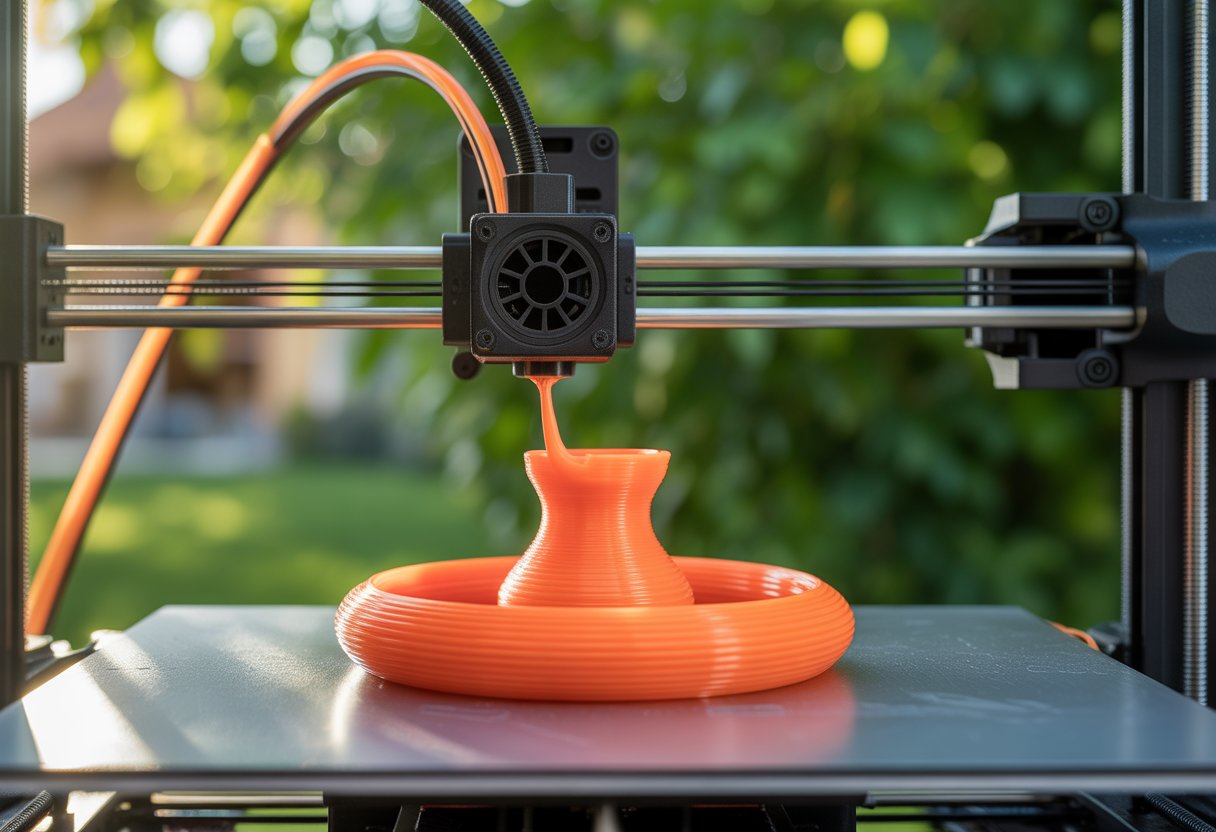
Choosing the best filament for outdoor use is critical if you want 3D prints that survive sun, rain, and temperature swings without fading, cracking, or warping.
Outdoor environments are tough on plastics. UV exposure, moisture, and heat can quickly destroy the wrong material. That’s why selecting a weather‑resistant filament — and printing it correctly — makes all the difference between a long‑lasting part and a failed project.
Among today’s options, ASA consistently ranks as the best overall filament for outdoor use, with PETG and Polycarbonate also performing well depending on the application.
This guide breaks down:
- What actually makes a filament outdoor‑safe
- The best filaments for outdoor 3D printing
- How ASA, PETG, ABS, and PLA compare
- Practical printing tips to maximize lifespan
Key Takeaways
- Choose filaments that fight off UV light and moisture.
- ASA, PETG, and ABS are strong outdoor options.
- Good print settings boost strength and lifespan.
When durability matters most, finding the best filament for outdoor use is key to long-lasting results. Start by exploring FDM filament, a dependable option for outdoor models that need structural strength.
What Makes a Filament Suitable for Outdoor Use?
Not all plastics are designed to live outdoors. When choosing a filament for exterior use, three factors matter most.

When you print stuff for outside, the material has to deal with sun, heat, and rain. You want a filament that won’t fade, crack, or get weak after a few weeks.
UV Resistance Importance
Sunlight beats up a lot of plastics. UV resistance helps prints keep their color and strength in the sun.
Filaments like ASA and PETG handle UV rays way better than PLA, which fades and gets brittle.
If your project sits in the sun, pick a filament with UV stabilizers. These slow down how fast the material breaks down.
|
Filament |
UV Resistance |
Outdoor Lifespan |
|
PLA |
Low |
Short |
|
PETG |
Medium |
Moderate |
|
ASA |
High |
Long |
You can also paint or coat your prints for extra UV protection. It’s not a bad idea if you want them to last even longer.
Temperature Resistance and Glass Transition Temperature
Outdoor temps bounce from hot to cold. A filament’s glass transition temperature (Tg) tells you when it starts to soften.
If the air gets close to the Tg, your print might warp or droop. PLA has a low Tg around 60°C, so it can sag in hot weather.
PETG and ASA handle heat better, with Tg values from 80–105°C.
|
Filament |
Approx. Tg (°C) |
Heat Resistance |
|
PLA |
~60 |
Low |
|
PETG |
~80 |
Medium |
|
ASA |
~105 |
High |
If your print will bake on a sunny deck or car dashboard, go for a filament with a higher Tg.
Moisture Absorption and Storage
Humidity makes some filaments soak up water from the air. That makes printing harder and weakens the finished part.
Nylon and PETG soak up more water than ASA or PLA.
Keep your filament dry in a sealed bag with silica gel or a dry box. If it gets wet, you can dry it out in a low-temp oven before printing.
Dry filament means your prints come out smoother, stronger, and more reliable for outside use.
For advanced material handling, don’t miss reading our article: Proper Handling of UV Curable 3D Printing Resins.
Top Filament Types for Outdoor Use

Some filaments just last longer outside. They fight off UV rays, don’t warp much, and stay strong even after months in the weather.
ASA Filament – Best Overall for Outdoor Use

Siraya Tech Fibreheart ASA-GF Filament
ASA filament works great for outdoor prints. It stands up to UV light and weather, keeping its color and shape even after months in the sun.
That makes it better than PLA or ABS for signs, garden tools, or car parts. ASA also bonds layers well and has a smooth finish.
You can sand or paint it for a clean look.
Pros:
- Excellent UV and weather resistance
- Less yellowing or fading
- Good strength and surface quality
Cons:
- Needs a heated bed and enclosed printer
- Slight odor while printing
PETG Filament – Best Balance of Durability & Ease

Fibreheart PETG-CF HF Filament
PETG balances strength, flexibility, and easy printing. It doesn’t crack easily and shrugs off water better than PLA.
It’s handy for planters, brackets, and covers. PETG prints with little warping and sticks well to the bed.
It resists impact and mild heat, though it’s not quite as UV-tough as ASA.
Pros:
- Easy to print with low warping
- Good impact and water resistance
- Smooth, glossy finish
Cons:
- Attracts dust and scratches
- May soften in very high heat
Polycarbonate Filament – Best for Extreme Strength & Heat
Polycarbonate (PC) is one of the toughest filaments out there. It handles high temps and big impacts, making it a solid pick for outdoor mechanical parts or covers.
It stays steady in heat and cold, but you’ll need a high printing temperature and an enclosed setup. PC is also really clear, which is nice for light covers or see-through parts.
Pros:
- Very strong and heat-resistant
- Excellent impact durability
- Keeps its shape under stress
Cons:
- Hard to print without an enclosure
- Soaks up moisture if not kept dry
If you’re using a Bambu filament alternative, you’ll appreciate its balance of quality and weather resistance.
Comparing ASA, ABS, and PLA for Outdoor Projects
ASA, ABS, and PLA all react differently to sun, rain, and temperature swings. That affects how long your prints last and how well they keep their shape.
Weather Resistance Differences
ASA handles outdoor weather best. It resists UV rays, so it doesn’t fade or get brittle in the sun.
It stands up to rain and heat too, making it great for garden tools, car parts, and signs.
ABS has decent heat resistance but lousy UV stability. Sunlight makes it yellow or crack over time. You can protect it with paint, but that’s more work.
PLA does the worst outside. It softens in heat and breaks down fast with moisture and sun. PLA is fine indoors but not for anything left outside.
|
Filament |
UV Resistance |
Heat Resistance |
Water Resistance |
Outdoor Rating |
|
ASA |
Excellent |
High |
Good |
★★★★★ |
|
ABS |
Poor |
High |
Fair |
★★☆☆☆ |
|
PLA |
Very Poor |
Low |
Poor |
★☆☆☆☆ |
Ease of 3D Printing
PLA is the easiest to print. Most printers can handle it with no enclosure or heated bed.
It sticks well and doesn’t warp much, so it’s good for beginners.
ABS is trickier. It warps if the bed isn’t hot enough or if there’s a draft.
You need an enclosed printer and decent ventilation since it gives off fumes.
ASA prints a lot like ABS, but it’s a bit more stable. It still likes an enclosure and steady temps, but it warps less and doesn’t smell as bad.
If you’ve printed ABS, ASA will feel familiar—maybe even a little easier.
Longevity and Durability
ASA lasts the longest outside. It keeps its color, shape, and strength even after months in the sun.
Printed parts stay solid and don’t turn brittle.
ABS stays strong in mild weather but weakens with too much UV. It’s better for shaded or covered spots.
PLA is the least durable. It can crack, fade, or warp after a short time outside.
For quick or decorative stuff, it’s fine, but for anything you want to last, ASA is the way to go.
Read our article, Injection Molding vs 3D Printing: Which Is Better? to see how outdoor durability compares between methods.
Printing Tips for Outdoor-Ready Parts
To get outdoor parts that last, focus on strong layer bonding and steady temperatures. Warping and cracking can be a pain since outdoor filaments like ASA or PETG are touchy about cooling.
Printer Settings and Hardware
Use an enclosed 3D printer to keep heat steady. Outdoor filaments like ASA and ABS need hotter print settings—nozzle at 240–260°C, bed at 90–110°C.
This helps layers stick together and stops weak spots.
Keep your print speed moderate, around 40–60 mm/s. Slower speeds boost strength and the finish looks better.
Turn part cooling fans down low or off when printing ASA or ABS. Too much cooling messes with layer bonding.
Make sure your bed is level and clean. Use glue stick or PEI sheets for better grip.
Getting the first layer to stick right stops curling.
Preventing Warping and Cracking
Warping happens when the bottom cools faster than the top. Keep your printer’s chamber warm and block drafts.
If your printer is open, you can make a simple enclosure from acrylic or even cardboard.
Use a heated bed and set it hot enough for your filament. Adding a brim or raft helps parts stay flat.
Store filaments in dry boxes or sealed bags with desiccant. Moisture makes prints weak and rough.
For big prints, try infill patterns like grid or gyroid. They add strength without making the part super heavy.
That way, your outdoor prints can handle stress and weather swings without falling apart.
Learn practical maintenance in our guide: How to Remove Filament Stuck in Toolhead Bambu Labs A1.
Best Applications and Use Cases for Outdoor Filaments
Outdoor filaments really shine when you pick the right material for the job. Use them for tough parts that live outside or for fun pieces that need to stay bright in the sun.
Functional Parts and Fixtures
Print brackets, mounts, and tool holders that can survive outside all year. PETG, ASA, and ABS fight off UV light and water, so they won’t crack or fade too fast.
PETG gives you strength and a bit of flex, which is handy for car parts and garden tools. ASA stands out for UV protection, and ABS stays tough and rigid for covered outdoor spots.
Go for higher infill—think 40–60%—and thicker walls to make parts last longer. If you want extra protection, a smooth finish or clear coat can help block out water and sunlight.
|
Filament |
Best Use |
Key Strength |
|
PETG |
Garden fixtures, tool parts |
Weather and impact resistance |
|
ASA |
Vehicle or outdoor mounts |
UV and heat resistance |
|
ABS |
Covered outdoor parts |
Strength and rigidity |
Decorative and Artistic Projects
Make planters, outdoor signs, sculptures, and yard décor that keep their color and shape in the sun. ASA and PETG beat PLA when it comes to fading outdoors.
If you want bold or glossy looks, ASA keeps colors sharp even after months outside. PETG gives a glassy, clean finish that feels modern.
For longer-lasting prints, paint or seal them. That extra layer keeps out UV and water, so your designs stay nice through rain and heat.
For users of Anycubic filament, outdoor projects can benefit from its consistent performance and ease of use.
Common Outdoor Print Failures & How to Avoid Them
Even with the best filament for outdoor use, poor printing or design choices can shorten a part’s lifespan. Below are the most common outdoor 3D printing failures — and how to prevent them.
1. UV Degradation and Brittleness
Problem:
Sun exposure breaks down many plastics, causing fading, cracking, and brittle parts.
How to Avoid It:
- Choose UV‑stable filaments like ASA
- Avoid PLA for outdoor use
- Apply UV‑resistant clear coats or paint
- Use darker or UV‑stable pigment colors
Note: ASA prints can last years outdoors with minimal degradation.
2. Warping and Deformation in Heat
Problem:
Parts soften or warp when temperatures approach the filament’s glass transition temperature (Tg).
How to Avoid It:
- Select filaments with high Tg (ASA, Polycarbonate)
- Increase wall thickness and infill
- Avoid leaving parts in direct sunlight on hot surfaces
- Design with ribs or reinforcements for flat areas
PLA often deforms in summer heat, even below 60 °C.
3. Layer Separation and Cracking
Problem:
Outdoor temperature swings cause internal stress, leading to cracked layers.
How to Avoid It:
- Print in an enclosed printer
- Increase nozzle temperature for stronger layer bonding
- Reduce cooling fan speed
- Print slower (40–60 mm/s)
Proper layer adhesion is critical for long‑term outdoor durability.
4. Moisture Damage and Weak Prints
Problem:
Humidity weakens prints and causes poor surface quality.
How to Avoid It:
- Store filament in dry boxes with desiccant
- Dry filament before printing if needed
- Choose moisture‑resistant materials like ASA or PETG
- Seal finished parts to block water intrusion
Wet filament leads to porous, fragile prints.
5. Mechanical Failure from Poor Design
Problem:
Outdoor parts fail due to stress, wind, vibration, or weight.
How to Avoid It:
- Use thicker walls (≥1.2 mm)
- Increase infill to 40–60%
- Choose stress‑resistant infill patterns (gyroid or grid)
- Round sharp corners to reduce stress points
Good design is just as important as material choice.
Final Thoughts
Finding the best filament for outdoor use means choosing materials that can handle UV rays, moisture, and temperature changes without losing strength or color.
Filaments like ASA, PETG, and certain nylons are top picks for long-lasting outdoor prints. With the right choice, your creations won’t just survive the elements — they’ll thrive in them.
So before your next outdoor project, take a moment to pick the right filament and save yourself from faded, brittle prints later. Your 3D printer can do amazing things outdoors — as long as you give it the right material to work with!
👉 Check out Siraya.tech filaments for durable, high-quality materials perfect for outdoor 3D printing projects.
Also, don’t forget to perfect your technique by reading our guide on Mastering Flexible Filament Printing on Creality K1, K1C.
Frequently Asked Questions
What's the top pick for weather-resistant 3D printing?
PETG and ASA lead the pack. PETG shrugs off moisture and doesn’t mind temperature swings. ASA is even tougher, with strong UV and weather resistance for outdoor parts.
Any filaments out there that won't warp in the sun?
ASA is your best bet. It stands up to sunlight without warping or fading. ABS can work too, but it needs some shade or it might not last as long.
Looking for strong filament options for garden projects - suggestions?
Try PETG for sturdy garden tools or decorations. It’s easy to print and doesn’t crack outside. If you want something even stronger, nylon is a solid choice.
Which 3D materials can handle getting wet without turning into a soggy mess?
PETG and ASA both handle water really well. They don’t soak up much moisture, so they stay strong even in rain. PLA, though, can get soft if it stays wet too long.
Need something that'll last in the heat - what should I use?
ASA handles heat better than most. It keeps its shape in hot weather and doesn’t soften as quickly as PLA or PETG. I’d pick ASA for parts that sit out in the sun.
Got any favorites for UV-resistant prints?
ASA stands out for UV resistance. It stays strong and keeps its color even after a lot of sun.
If you can’t find ASA, try a UV-resistant coating on PETG prints. That gives them some extra protection.