
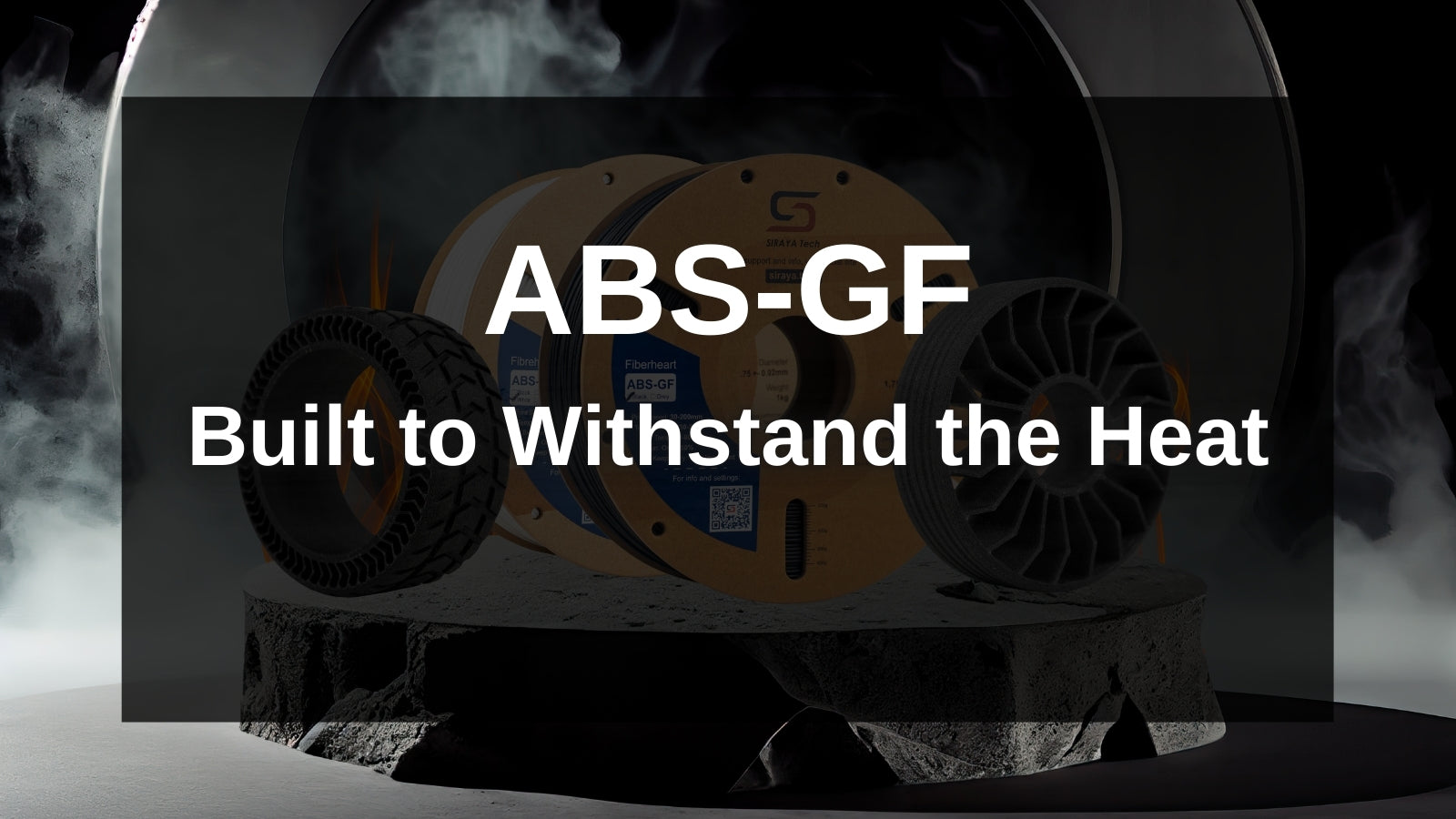
When evaluating materials for functional 3D printing, few properties are as critical as ABS heat deflection temperature (HDT). While ABS is widely known for its strength and impact resistance, not all ABS filaments perform equally when exposed to heat. For parts that must maintain their shape, strength, and reliability in elevated temperatures, HDT becomes a defining performance metric.
Siraya Tech Fibreheart ABS‑GF is specifically engineered to address this challenge. With a heat deflection temperature of 93°C, it exceeds the capabilities of standard ABS and many reinforced alternatives, making it a strong choice for demanding industrial and high‑temperature applications.
Understanding ABS Heat Deflection Temperature

Heat deflection temperature refers to the point at which a material begins to deform under a standardized load. In practical terms, ABS heat deflection temperature determines how well a printed part can resist softening, warping, or bending when exposed to heat during real‑world use.
This property is especially important for components used near engines, motors, electronics, or in enclosed environments where heat buildup is unavoidable. A higher HDT allows ABS parts to retain dimensional accuracy and mechanical integrity, even after prolonged exposure to elevated temperatures.
Standard ABS typically offers an HDT in the mid‑80°C range, which is sufficient for basic applications but often inadequate for professional or industrial use cases. Reinforced formulations like ABS‑GF are designed to push those limits further.
Key Benefits:
- Superior HDT (93°C): Unmatched thermal performance.
- Premium ABS Material: Enhanced durability and quality.
- Glass Fiber Reinforcement: Increased strength and rigidity.
- Ideal for Demanding Applications: Perfect for automotive, industrial, and high-heat uses.
Siraya Tech ABS‑GF and Its 93°C Heat Deflection Temperature
Siraya Tech ABS‑GF achieves its enhanced thermal performance through a glass fiber‑reinforced ABS formulation. The addition of glass fibers significantly increases stiffness and heat resistance, reducing deformation under load while maintaining the core benefits of ABS.
With an HDT of 93°C, Siraya Tech ABS‑GF delivers noticeably improved performance in environments where standard ABS may soften or fail. This higher ABS heat deflection temperature allows printed parts to maintain structural integrity when exposed to mechanical stress and sustained heat, making the filament suitable for functional prototypes and end‑use components alike.
Don't settle for filaments that falter under pressure. Choose Siraya Tech Fibreheart ABS-GF and experience the difference in high-performance 3D printing.
Why ABS Heat Resistance Is Critical in Real‑World Applications
In many real‑world scenarios, printed parts are exposed to temperatures well beyond what desktop materials are designed to handle. Automotive interior components, industrial fixtures, tool holders, and machine housings all experience heat generated by surrounding systems or environmental conditions.
In these situations, insufficient ABS heat deflection temperature can lead to warping, sagging, or long‑term deformation. Siraya Tech ABS‑GF minimizes these risks by offering enhanced thermal stability, ensuring that parts remain dimensionally accurate and mechanically reliable over time.
This makes ABS‑GF particularly valuable for professionals who need printed components to perform consistently outside of controlled lab environments.
Mechanical Strength and Dimensional Stability
Beyond heat resistance, glass fiber reinforcement provides notable improvements in rigidity and load‑bearing capability. Parts printed with Siraya Tech ABS‑GF exhibit increased stiffness and reduced flex compared to standard ABS, which is essential for structural components and mechanical assemblies.
The improved dimensional stability also means that parts are less likely to creep or distort when subjected to continuous stress and heat. Combined with its elevated ABS heat deflection temperature, this makes ABS‑GF a dependable choice for precision components that must retain their shape over time.
How ABS‑GF Compares to Standard ABS
While standard ABS remains popular for general printing, it can fall short in demanding environments. Siraya Tech ABS‑GF offers a clear upgrade in thermal and mechanical performance without sacrificing the familiar processing characteristics of ABS.
The higher heat deflection temperature, improved rigidity, and enhanced durability position ABS‑GF as a professional‑grade material suited for applications where failure is not an option.
Printing ABS‑GF Successfully
To fully benefit from the increased ABS heat deflection temperature, proper printing conditions are important. An enclosed printer helps maintain stable temperatures during printing, reducing internal stress and warping. Because glass fibers are abrasive, hardened steel or wear‑resistant nozzles are recommended to ensure consistent extrusion and long‑term nozzle life.
When printed correctly, Siraya Tech ABS‑GF produces strong, high‑quality parts capable of handling both thermal and mechanical stress.
Conclusion: Choosing the Right ABS for Heat‑Sensitive Applications
ABS heat deflection temperature is a crucial factor when selecting a filament for functional 3D printing. For projects that require higher thermal resistance, dimensional stability, and long‑term reliability, Siraya Tech Fibreheart ABS‑GF stands out as a robust solution.
With its 93°C HDT, glass fiber reinforcement, and premium ABS formulation, ABS‑GF bridges the gap between standard desktop materials and industrial‑grade performance—allowing makers, engineers, and manufacturers to print parts that perform reliably even in high‑heat environments.