
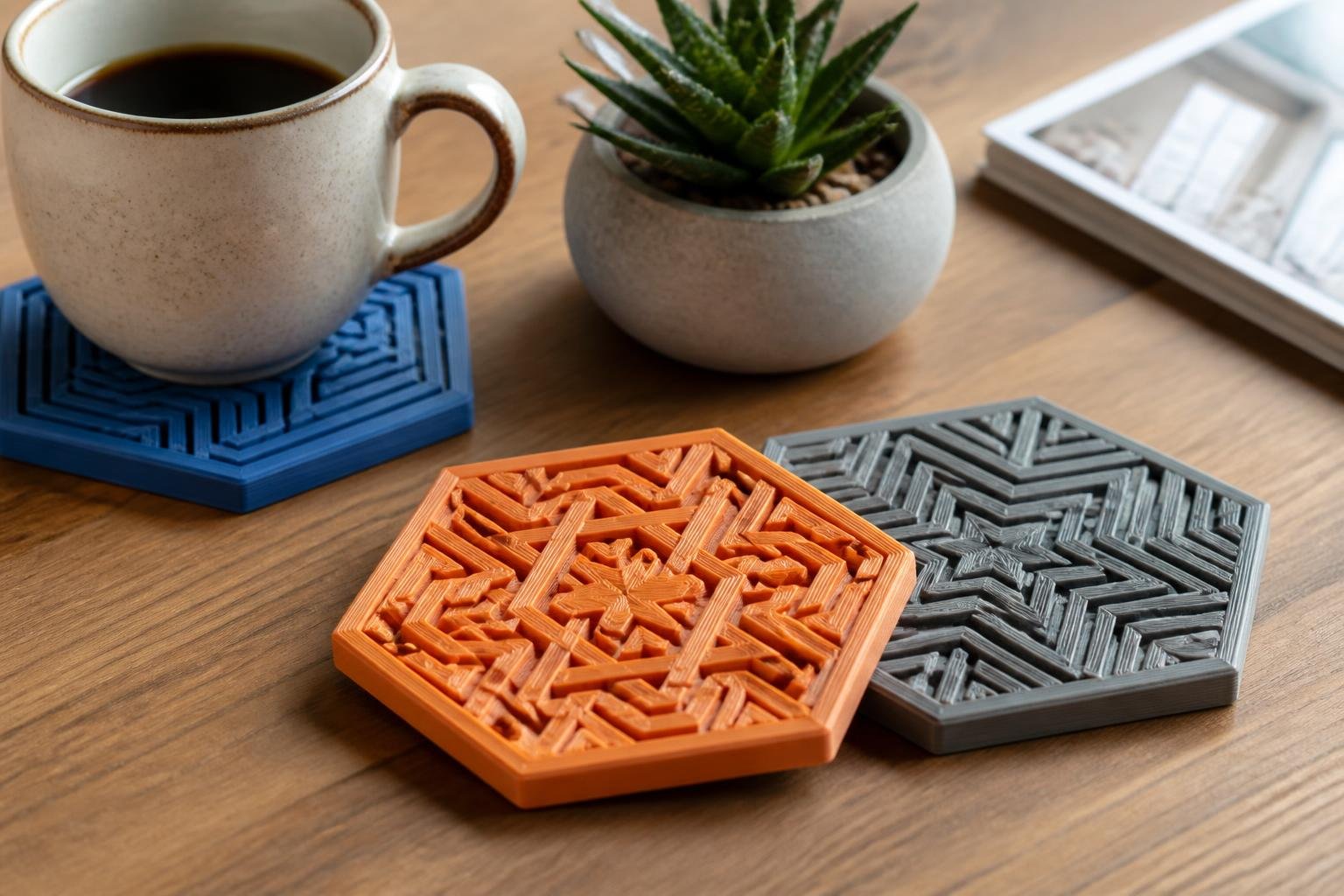
Whether you want a personalized set for your home or a creative gift, coasters are the perfect project for any skill level. They're quick to iterate, cheap to reprint, and genuinely useful.
This guide covers everything: material choice, design ideas, print settings, and finishing techniques to get results you'll actually want on your coffee table.
- PLA vs. PETG: PLA works for decorative coasters, but PETG handles daily use near hot drinks much better.
- Print settings: Use 0.2mm layer height, 3–4 walls, and 15–20% infill for a solid, durable coaster.
- TPU for non-slip: Flexible TPU grips surfaces and won't scratch furniture.
- Resin for detail: Resin-printed coasters offer smoother surfaces and finer detail than FDM.
- Great for gifting: Personalized coaster sets are one of the most practical 3D printed gifts you can make.
- Beginner-friendly: Multi-color and texture designs make coasters an ideal first creative project.
Why 3D Print Your Own Coasters?

Store-bought coasters come in limited designs and rarely match your space exactly. 3D printing opens up options mass production can't touch.
- Personalize with names, monograms, logos, or custom artwork.
- Match your exact color scheme or interior design.
- Experiment with textures — wood grain, geometric patterns, topographic maps.
- Create themed sets for parties, weddings, or holidays.
- Reprint replacements instantly when one wears out.
Coasters also make excellent test prints for new filaments or slicer settings. They're flat, small, and fast — so you can iterate without wasting material.
Best Materials for 3D Printed Coasters
The material you choose affects how your coasters look, feel, and hold up to hot or cold drinks. Here's how the main options compare.
PLA
PLA is the most popular choice for decorative coasters. It's easy to print, comes in hundreds of colors, and produces smooth surfaces.
The drawback is heat sensitivity. PLA starts softening around 60°C, so a very hot mug can warp it over time. For room-temperature drinks or display coasters, PLA is perfectly fine.
Specialty PLA variants — wood-fill, marble, or color-changing — add interesting visual effects without any extra complexity.
PETG
PETG is the better choice for coasters used daily with hot drinks. It handles temperatures up to around 80°C without softening and is more impact-resistant than PLA.
It's slightly trickier to print, but the result is a durable coaster that lasts years of daily use.
TPU
Flexible TPU makes coasters that grip surfaces and won't slide around. They also won't scratch delicate furniture finishes.
Shore 95A TPU is the easiest to print and rigid enough to hold its shape while still giving that satisfying flexible feel. Browse Siraya Tech's Flex TPU Filament collection for options.
Resin
For the finest detail and smoothest surfaces, resin is unmatched. Resin coasters capture intricate patterns, sharp text, and thin line work that FDM printers can't.
Use a tough or durable resin for coasters that see daily use. Note that resin coasters shouldn't be used for direct food contact unless the resin is specifically certified for it.
Standard 3D printing resins are not tested for prolonged food contact. For coasters holding drinks in cups or glasses, this isn't a concern since the drink doesn't touch the coaster directly. Don't use uncoated resin coasters as plates or direct food surfaces.
Design Ideas Worth Trying
The best 3D printed coasters go beyond a plain flat disc. Here are designs that stand out.
- Topographic maps — Your favorite mountain, city, or trail. FDM layer lines naturally enhance the look of elevation contours.
- Geometric patterns — Hexagonal grids, Voronoi meshes, or tessellated shapes. These print without supports and look great in contrasting colors.
- Multi-color filament swaps — Print a dark base layer, then swap to a contrasting color for the top surface.
- Lithophane coasters — Images revealed when held up to light. Best in white PLA at 100% infill with thin walls.
- Textured surfaces — Wood-fill, marble, or fuzzy skin settings add tactile interest and naturally hide layer lines.
Print Settings for Perfect Coasters
Coasters are simple prints, but the right settings make a big difference in the finished result.
| Setting | Standard | Fine Detail / Lithophane |
|---|---|---|
| Layer height | 0.2mm | 0.12mm |
| Walls | 3–4 perimeters | 3–4 perimeters |
| Infill | 15–20% | 100% (lithophanes) |
| Top layers | 4–5 layers | 4–5 layers |
| Bottom layers | 3–4 layers | 3–4 layers |
| Print speed | 50–60 mm/s | Slow down for top surface |
| Supports | None needed | None needed |
Finishing Your Coasters

A little post-processing takes your coasters from "3D printed object" to "something you'd proudly display." Here are the methods worth knowing.
Sanding
Start with 400-grit sandpaper and work up to 800-grit to smooth top surfaces and remove visible layer lines. Wet sanding works best for PLA and PETG — it keeps dust down and leaves a smoother result.
Clear Coating
Polyurethane or acrylic spray adds a protective, waterproof layer. This matters most for PLA coasters used with drinks.
For resin prints, Siraya Tech's Aegis coating system adds a professional finish that protects against UV yellowing and moisture.
Cork Backing
Adhesive cork sheets glued to the bottom prevent sliding and protect furniture. Buy cork sheets in bulk and cut them to size with scissors — quick and inexpensive.
Epoxy Flooding
A self-leveling epoxy pour creates a glass-like surface over textured or multi-color prints. This is the best way to get a premium, restaurant-quality look from a basic FDM print.
Getting Sharper Detail With Resin Printing
FDM coasters are great for bold patterns and textures. But if you want crisp text, fine line work, or intricate relief patterns, an LCD or DLP resin printer delivers precision FDM can't match.
Siraya Tech's Fast ABS-Like Resin is a solid choice for coasters that need to be tough and non-brittle. For a glass-like transparent coaster that shows off embedded designs, Craft Ultra Clear Resin is worth exploring.
Coasters as Gifts and Products
3D printed coasters are one of the most giftable things you can make. Personalize them with a name, wedding date, sports team logo, or inside joke.
Sets of 4–6 matching coasters make excellent housewarming gifts, wedding favors, or holiday presents. If you're selling coasters, focus on finishing quality — sanded, sealed coasters with cork backing feel professional and justify a higher price.
Final Thoughts
3D printed coasters combine creativity, practicality, and low material cost into one of the most satisfying projects in the hobby. The right material, a few minutes of finishing, and you'll have coasters that look great on any table.
Start with PETG if you want durability, TPU if you want grip, or resin if you want detail. Every option is worth trying.
Browse Siraya Tech's 3D printing resins and filament collection to find the right material for your next coaster project.
Related Reading on Siraya
- Resin Art Ideas for 3D Print
- How to Make Print Transparent Clear
- Clear Coat for 3D Prints: How to Apply
- Sanding 3D Prints: Complete Guide
- Best Filament for Functional Parts
Frequently Asked Questions
What is the best material for 3D printed coasters?
PETG is the best all-around choice for functional coasters used daily with hot drinks. PLA works well for decorative coasters that don't face extreme heat. TPU makes non-slip, furniture-friendly coasters with a rubber-like feel. Resin gives the finest detail and smoothest surfaces for display or decorative use.
Are 3D printed coasters heat resistant?
It depends on the material. PLA softens around 60°C and can warp under very hot mugs. PETG handles temperatures up to 80°C comfortably, making it the better choice for coasters used with hot beverages regularly.
Can you make 3D printed coasters waterproof?
Yes. Print with at least 4 top and bottom layers and 3–4 walls to create a sealed surface. Applying a clear coat of polyurethane or acrylic spray adds a waterproof barrier on top. Resin coasters are naturally waterproof straight off the printer.
Are 3D printed coasters food safe?
Standard filaments and resins are not rated for prolonged food contact. For coasters used with drinks in cups or glasses, this isn't a concern since the liquid doesn't touch the coaster. Don't use uncoated PLA or resin coasters as direct food plates or surfaces.
How long does it take to 3D print a coaster?
A single coaster typically takes 1–3 hours on an FDM printer depending on size, detail, and speed settings. Simple designs at 0.2mm layer height usually print in about 1–2 hours. Detailed designs or lower layer heights take longer.
What are good coaster designs for beginners?
Start with flat geometric patterns, simple text, or basic shapes. Hexagonal grids, circular patterns with raised rims, and two-color filament swap designs are all beginner-friendly. Free STL files are available on repositories like Printables and Thingiverse.